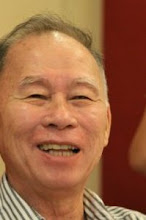
“LADIES FIRST”

        For the last 60 or so years, I have been always gentlemanly. In my recent sojourns to the malls and public places, I was practically being pushed to walk ahead of my lady companions in walkways, escalators and elevators – to make me realize that I have become a weak senior citizen. I was also being offered the use of a walking stick! I look at the mirror and I understand.
        The changing of the guard has started. I am no longer in command physically, emotionally psychologically and perhaps, even economically.
        The 3 ladies that I have allowed to bully me around are my wife and my 2 daughters. I refuse to be pushed around by anyone else. Especially pushy is my 11-year old grandson, who does the easy route of getting his way by giving me a bear hug, which he learned from his jujitsu lessons.
        I have seen too many dear people leave this world, too soon; before ​ they even understood the great freedom that comes with aging.
        Only my dear roommate cares if I choose to watch TV, read or play on the computer​ until 4 AM, or sleep until noon the next day.  With the accompaniment of youtube, I sing to the nostalgic tunes of the 50s, 60s & 70s and undying songs of the original Ateneo Glee Club..
        I know I have become forgetful. But then again, some sad episodes of my life are just as well forgotten.  And those worth remembering, I eventually remember, especially with the help of my friend Google.
        Sure, over the years, I have known deep heartbreak. But broken hearts are ​ what give us strength, and understanding, and compassion. A heart ​never broken, is pristine, and sterile, and will never know the joy of being human.
        I am so blessed to have lived long enough to allow my head to go bald, and to have my youthful laughs be forever etched into deep ​ furrows on my face. So many have never laughed, and so many have died ​ before their hair could turn silver.
        As one gets older, it is easier to be positive. You care less about what other people think. I don't question myself anymore.  I even ​ think I've earned the right to be wrong.

        I like being old because age has set me free. I ​like the unobtrusive person I have become. I am not going to live forever, but ​ while I am still here, I will not waste time lamenting what could have ​ been, or worrying about what will be. And I shall dance and run every time I feel like it – until, of course, I feel the huffing and puffing and the weakness in my legs. 

Leave a comment

Aging of Body Systems

        As we age, our body's organs and other systems make changes. These changes alter our susceptibility to various diseases. Researchers are just beginning to understand the processes that cause changes over time in our body systems. Understanding these processes is important because many of the effects of aging are first noticed in our body systems. Here is a brief overview of how some body systems age:

        1.  Heart Aging: The heart muscle thickens with age as a response to the thickening of the arteries. This thicker heart has a lower maximum pumping rate.         
        2.  Immune System Aging: T cells take longer to replenish in older people and their ability to function declines.        
        3.     Arteries and Aging: Arteries usually stiffen with age, making it more difficult for the heart to pump blood through them.        
        4.     Lung Aging: The maximum capacity of the lungs may decrease as much as 40 percent between ages 20 and 70.          
        5.    Brain Aging: As the brain ages, some of the connections between neurons seem to be reduced or less efficient. This is not yet well understood.         
        6.     Kidney Aging: The kidneys become less efficient at cleaning waste from the body.       
        7.     Bladder Aging: The total capacity of the bladder declines and tissues may atrophy, causing incontinence.
        8.     Body Fat and Aging: Body fat increases until middle age and then weight typically begins to decrease. The body fat also moves deeper in the body as we age.          
        9.     Muscle Aging: Muscle tone declines about 22 percent by age 70, though exercise can slow this decline.
       10.   Bone Aging: Starting at age 35, our bones begin to lose density. Walking, running and resistance training can slow this process. Sight and Aging: Starting in the 40s, difficulty seeing close detail may begin.      
       11.  Hearing and Aging: As people age, the ability to hear high frequencies declines.

Behavioral Factors
The good news is that many of these causes of aging can be modified through your behaviors:
1.       By eating foods loaded with antioxidants, you can minimize damage caused by free radicals.
2.       By exercising, you can limit bone and muscle loss.
3.       By keeping your cholesterol low, you can slow the hardening of your arteries and protect your heart.
4.       By practicing mental fitness, you can keep your brain sharp.


        Lifestyle factors have also been shown to extend life. Rats and mice on a calorie restricted diet (30 percent fewer daily calories) live up to 40 percent longer. Positive thinking has also been shown to extend life in people by up to 7.5 years.

Leave a comment

Insights: Post-Reunion Revelations


        The Tampoy ancestral house of the De Leon clan in Malolos yesterday, February 16, 2014, became the venue of the clan’s first-ever reunion based on participation. The gathering was made up of 3 surviving generations and attended by over 100 relatives. The clan is recorded to start from Anastacio de Leon or “Inkong Tasio”, my great-grandfather. 
       What caught my particular attention was the revelation of a senior member that my grandfather, the first mayor of Malolos of the Philippine republic, a lawyer, who had the code-name “Bagwis” in the anti-friar movement, advised his children to take up any academic pursuit, except law. When asked by a youngster why, she said she was not told why, but was met by some comments from the same youngsters: “corruption”.
        A quick survey of the attendees high-lighted the absence of lawyers and politicians in our clan. Of course, I discount the possible presence of non-direct descendant of the clan, who may have been married into the clan.
        Briefly, this wake-up call explains why I did not know until recently about political dynasties and the fortunes attached to being in one.  It also explains why the clan is enjoying coming home together in the my grandfather’s preserved house, because among us we did not have mansions that may only embarrass us in explaining how they were acquired. It also explains why 20 percent of the “parenting age” have migrated.
        I also understand now why political dynasties are built, and the resistance to any enabling law that will stop or at least moderate dynasty building.

For better insight, click on

http://www.philstar.com/opinion/2014/02/17/1291262/where-our-taxes-go

Leave a comment

MEMORIES

        This commentary serves to introduce the excellent column of Ana Marie Pamintuan of The Philippine Star.   
        This is particularly addressed to my colleagues in the pre-departure area, the not-so-young who are keenly aware of what transpired during the Martial Law years and lived through other horrors thereafter.
         From the time we Filipinos found ourselves free from colonial rule to be on our own, successive Philippine presidents have led us gradually down to perdition. We hit a snag during Martial Law years and exalted in the successful People Power Revolution hoping the spiral had been halted.
       But then the prevailing feudalism and political dynasties were resurrected and corruption continued unabated gathering momentum. People power vainly tried to intervene in more than one instance, but our damaged electorate put back in power the same feudal families. The rich got richer and the poor became poorer!
        Then, out of the blue, a neophyte from the same feudal mould and following the tried and true political route, was elected president. To everyone’s surprise, through his heart-felt battle cry of treading the straight path, he has since put the Philippines on the way to become an Asian Tiger. Unfortunately, his efforts have stirred up enough dust and dirt that forced the traditional feudal lords to be in offensive mode and again ready to negate whatever gains have already been attained.
        After the Supertyphoon Yolanda’s fury, foreigners assisting survivors were impressed saying that our country is a country of ever smiling and resilient people. It’s a good tourism gimmick, but it can indicate a negative image – we easily forget.
        This short memory lapses seem to have been the destiny of this country for decades ever since Filipinos took the helm of nation-building in their own hands. For some time going into the ’60s, the Philippines was considered the shining star of the East.
        Then, for some reason, our country overnight found itself as the sick man of Asia. Even shamefully, in recent years, we’d heard of Vietnam and Laos being praised for their vibrant progression towards economic salvation. That was long after the world acknowledged the emergence of Malaysia, Singapore, Thailand and China as economic powers.
        We have had our share of colorful presidents, who have tried every kind of recipe in the book to cook up a path of economic emancipation, including holding midnight drinking cabinets and lengthening their stay in government over the regular prescribed period.
        They say six years is too short for a good president, and too long for a bad one. I’d like to think that time is not really the big issue here.
        Here lies the crux of the matter: it should be the mindset of both our elected officials and those that elect them that a public post is more than a position of trust. We must have people in governance who will truly work for the country’s 100 million people’s welfare.
       Why do we never learn?
        There are so many reasons. One lies in our educational system which has diminished not just scholarship but excellence. There is less emphasis now on the humanities, in the study of the classics which enables us to have a broader grasp of our past and the philosophies of this past. We envy Hindus and Buddhists who have in their religion philosophy and ancestor worship that build in the believer a continuity with the past, and that most important ingredient in the building of a nation — memory.
        We even allow disgraced criminals to be recycled in government service.
        The intelligent person is aware of his shortcomings. He is humble enough to ask the opinion of those who know more than him on particular subjects. If he is a government hierarch, he will surround himself with advisers who can supply him with guidance and background possessing more knowledge, experience and wisdom than him. Such an official is bound to commit fewer mistakes because he knows himself. But, of course, how can he get there unless ironically he had played along with predecessors.
        This is how we show our perennial weakness for short-sightedness and apathy. Patience and fortitude have been traits that Filipinos take pride in - even to a fault. We say “bahala na” suffering incompetence and shabby work without a whimper of protest. We smile shrugging off misery that normally would have made other peoples scream and run amuck.
        Again, the world looks at the Philippines as being at the brink of joining other emerging economies. This SHOULD be flattering to ALL Filipinos. We are given a head-start that is grounded on something substantial that will really form the basis for future growth.
        Needless to say, we have to unify and get our act together this time. The reality is that if we bungle this opportunity, the chance to move forward may not come again in a very long time. Think Filipino! You have a right to know and keep remembering.

Leave a comment

CONSEQUENT CHALLENGE

Economic freedom: Phl 89th out of 178 countries
By Jose Katigbak, STAR Washington bureau (The Philippine Star) | Updated January 15, 2014 - 12:00am

WASHINGTON – The Philippines scored 60.1 points and was ranked 89th freest country in the world out of 178 rated in the 2014 Index of World Economic Freedom.
        In 2013, the Philippines was ranked in 97th place with a score of 58.2 points.
        “The Philippines has shown consistent score improvement in the index for a number of years, showing a dedication to reform amongst the country’s leadership,” said Terry Miller, director of the Heritage Foundation’s Center for International Trade and Economics.
“Rule of law continues to be a major concern, as ownership structures remain from the time of President Ferdinand Marcos. Philippine leaders must look to strengthen the rule of law and combat corruption if they want to sustain their score improvements,” he said.
        While lauding the Aquino administration’s legislative reforms to enhance the investment environment and incentivize broader-based, private-sector job growth, the report said lingering institutional challenges will not be overcome without a deeper commitment to reform.
        It said more effective anti-corruption measures need to be firmly institutionalized. . . . . .

-o0o-
        AND THIS IS WHERE WE STAND TODAY. THE AQUINO ADMINISTRATION IS CHALLENGED TO INSTITUTIONALIZE ANTI-CORRUPTION MEASURES.
        Where lies the crux of decades old corruption? We all know by now that the core is lodged in the system of pork barrel distribution under the control of trapos and epals in political dynasties.
        If PNoy can effectively abolish any form of pork barrel in the government budget (as he is supposed to be doing now), half the battle is won.
        The other half lies in driving home the point that it is the duty of every citizen to participate in the governance of his/her own community. If we want to erase the source of corruption in government, let us begin by actively participating in barangay affairs.
        In every barangay, it is the barangay captain who takes control of his or her particular barangay through his or her barangay assembly and development council. It is general practice for the barangay captain to choose and appoint the residents of his/her choice to comprise the assembly and council.
        We all know that Barangay elections are under the influence of the trapos and epals who are on the bureaucratic saddle. Hence, control of the barangay assemblies is therefore effectively under the incumbent political dynasties - who therefore become the de facto BOSSES.
        Since most residents refuse or do not care to vote in barangay elections, the rest of the citizenry are disenfranchised and powerless to curb age-old corruption – effectively diverting hard-earned economic gains from those who need them most.

Leave a comment

Search

Swedish Greys - a WordPress theme from Nordic Themepark. Converted by LiteThemes.com.